
Your buyers are asking AI engines which products to consider. Visibility+ is our managed authority service that helps your brand show up in the answers.


Visibility+ is dofollow.com's managed AI visibility service for B2B companies.
We track the questions your buyers ask, identify which sources AI engines cite, and work to get your brand included. You'll see where you're being recommended, where competitors appear instead, and what we're doing to close those gaps.
A dedicated strategist manages the program, with weekly tracking across engines such as ChatGPT, Perplexity, Google AI Overviews and Google AI Mode.
AI engines often draw on third-party websites when answering questions about products and vendors. If those sources don't mention your brand, you may be missing from the answer.
We analyzed 18 client projects between September 1 and October 13, 2026. Across their 25 most-cited pages per project, we counted 46,861 AI citations. Third-party pages accounted for 54.6%.

In 16 of the 18 projects, a third-party listicle, comparison, alternatives page or review profile ranked among the five most-cited pages.
That's why Visibility+ focuses on the sources influencing AI answers, not just your website.
SEO helps your pages rank in Google. Answer engine optimization (AEO) focuses on getting your brand named in AI answers.
The two overlap, but they require different measurements and tactics.
| SEO | AI visibility | |
|---|---|---|
| What's measured | Where your pages rank | How often AI answers name you |
| Main lever | Your pages and the links pointing to them | Being named on the pages engines cite |
| Headline metric | Rankings and organic traffic | Share of answers that name you |
Different AI engines also rely on different sources. In May 2026, Kevin Indig analyzed Omnia citation data from ChatGPT, Perplexity and Google AI Overviews. In a 20,000-prompt sample, 91% of cited URLs appeared in only one engine for the same prompt.
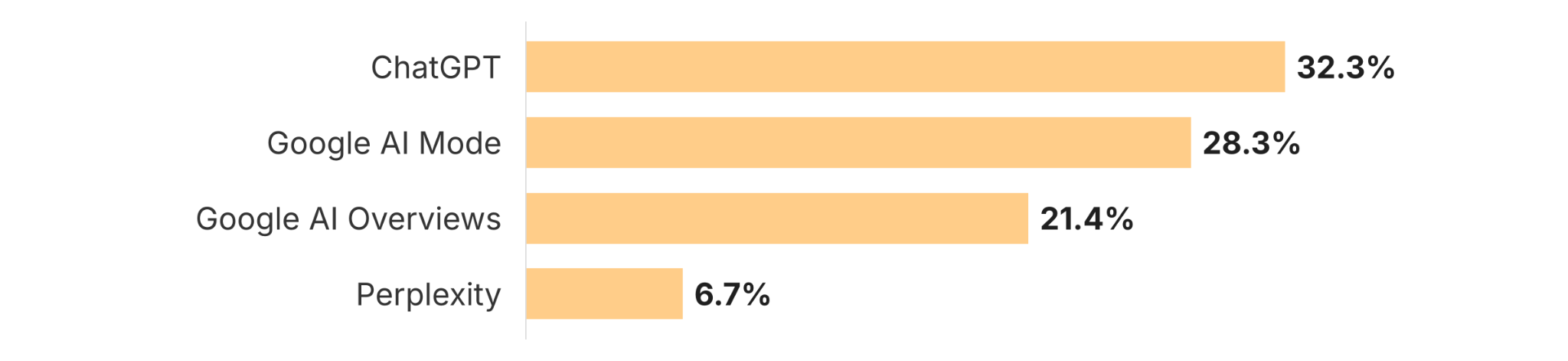
Our own tracking shows similar differences.
We start by finding where your brand is missing. Then we identify the sources and actions most likely to improve your presence.
Together, we build a set of at least 50 buyer questions, from early research through vendor comparisons.
Many questions don't mention a brand. That matters because your company has to earn its place in the answer.
We run the questions weekly across the engines in your program, recording answers and cited sources.
We report questions naming your brand, a competitor, and no brand separately. Our discovery measure is the share of answers naming you on questions that name no brand. We keep the question set consistent to measure changes over time.
Every question receives a buyer-journey stage and one of three statuses:
The first two weekly runs establish your baseline. A single run isn't enough to judge performance because AI answers change.
For every question you don't own, we examine the cited sources.
If third-party articles shape the answer, we look for ways to earn inclusion. If engines rely on brands' own websites, we identify the changes your site may need.
Every gap goes into one of four work areas. You'll receive the diagnosis in your month-one Authority Audit.
We pursue four types of placements: listicle inclusions, comparison inclusions, brand mentions and editorial links.
The buyer question determines the approach. A "best X for Y" question may call for listicle inclusion. An "X vs Y" question points toward comparison content.
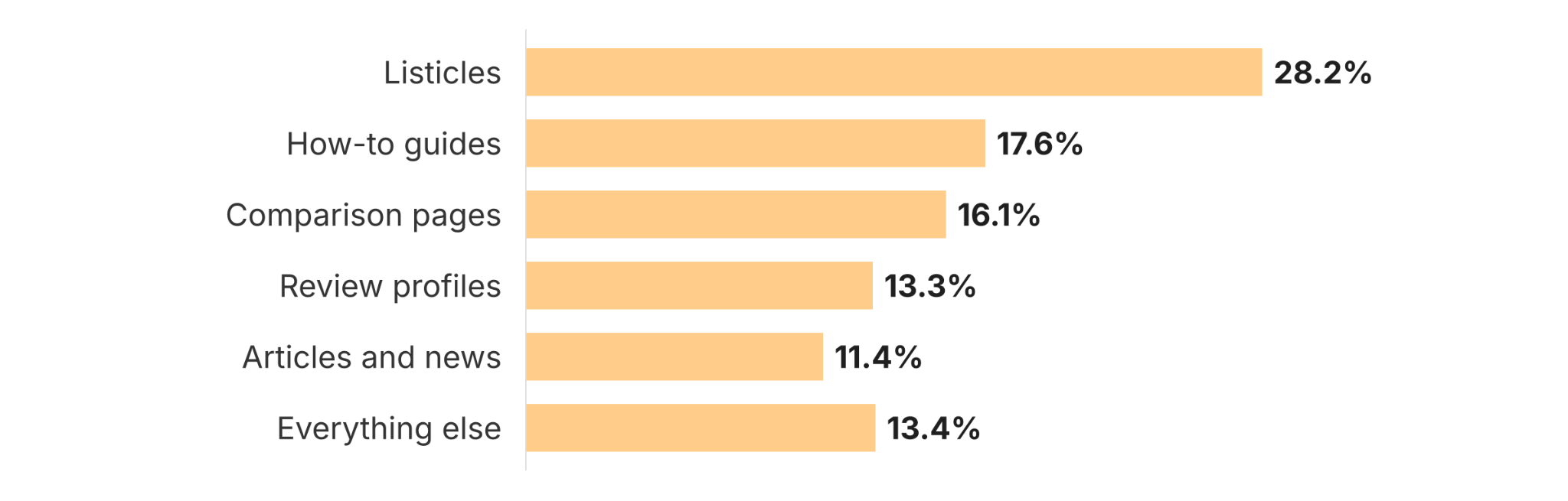
Listicles accounted for 28.5% of third-party citations in our client data.
We work with relevant publishers and evaluate other pages AI engines already cite. The host article must have been published or updated within the past 12 months.
We exclude sponsored-labelled pages, self-promotional rankings and reciprocal list networks.
We record a placement as delivered when it is live and meets the agreed criteria. Separately, we track whether AI answers name your brand and cite the source.
We check placements two and six weeks after publication. We generally need about eight weekly runs before reporting a meaningful change.
Your reports show the starting baseline, placements made and movement across tracked questions.
Not every visibility gap requires the same solution.
| Work area | When it applies | What we do |
|---|---|---|
| Placement | Engines cite third-party pages that leave you out | Listicle and comparison inclusion, brand mentions and in-article links on independent sites |
| Authority | Your page ranks, but engines pass it over | Links from relevant sites to that page, with anchors matched to the pages ranking above it |
| Awareness | Engines don't connect your name with your category | Brand mentions over time and one consistent description of your company across profiles |
| Schema | Engines rely on brands' own pages, but yours is difficult to understand or quote. | Recommend improvements to page clarity, content structure and appropriate structured data for your team to implement. |
Some fixes belong on your website. We identify the pages and changes needed, but your team handles on-site content updates.
Visibility+ is a managed service, not software you have to operate yourself.
In month one, your strategist delivers:
Authority Audit: Where your brand is missing, why, and which work area applies.
Buyer Journey x Prompt Map: Your tracked questions organized by buying stage and visibility status.
Baseline deck: A record of your starting performance.
Ongoing deliverables include two Loom walkthroughs each month and an AI Search Performance report. At three months, we review progress against your baseline.
| Report metric | What it shows |
|---|---|
| Unbranded AI visibility | Share of answers naming you, on questions that don't name a brand |
| Branded AI visibility | Share of answers naming you, on questions that name your brand |
| Average AI position | Where you appear in the answers that name you |
| Placements built | Placements that went live that month |
| Organic traffic | Google traffic, to show how search and AI move together |
See our pricing page for current plans.
We track dofollow.com's visibility using the same approach.
From September 1 to October 19, 2026, we monitored 50 questions. Each had up to 28 answers across seven weekly runs and four engines.
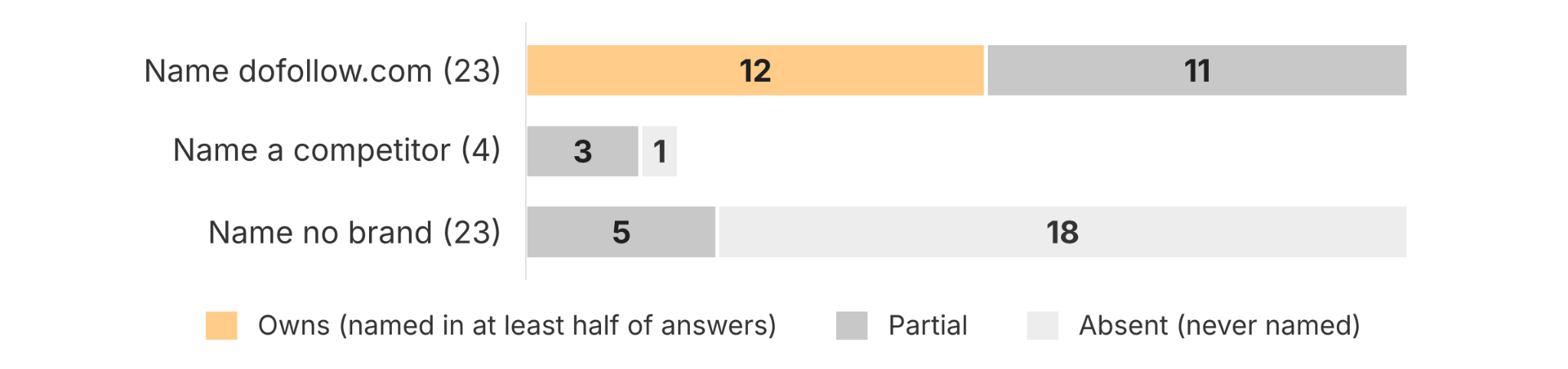
Of the 23 questions naming dofollow.com, we own 11 and are absent from none.
The challenge is different for questions that don't name a brand. We own none of those 23 questions and are absent from 18.
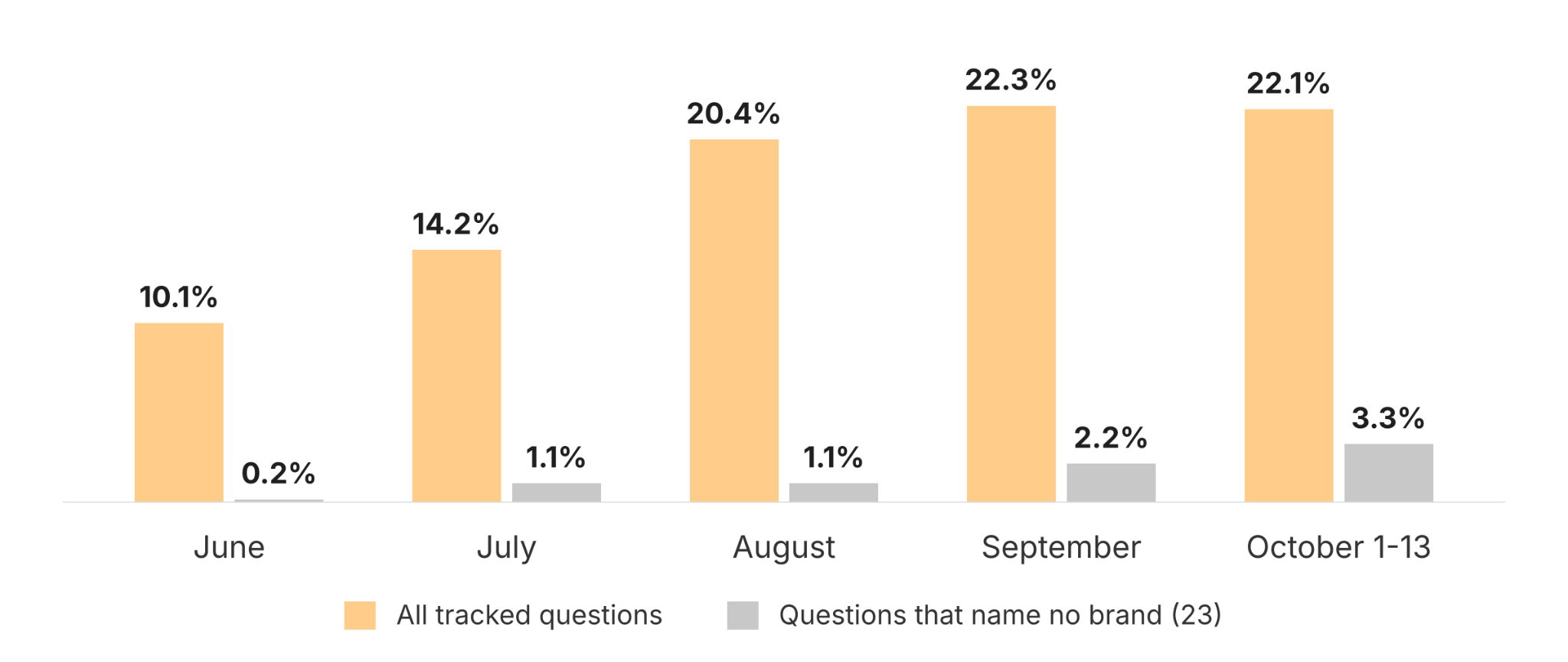
Across all tracked questions, the share of answers naming dofollow.com rose from 10.1% in June to 22.3% in September. These monthly figures use the questions tracked at the time; June includes five questions later archived. They are not a fixed-cohort comparison.
Among 11 agencies in our tracking set, we moved from fourth to first.
For the 23 questions naming no brand, our share increased from 0.2% in June to 2.2% in September.
These are observed results, not a controlled experiment. You can explore the full figures on our results page.
Traditional search authority and AI visibility can reinforce each other.
In February 2026, Lily Ray studied 11 selected site subfolders that had lost Google organic traffic. Their AI citations had also declined by an average of 22.5%. It's a small observational sample, not proof that the traffic losses caused the citation declines.
Our link building service strengthens the pages you want to rank in search. Visibility+ focuses on the sources AI engines use to answer buyer questions.
When your own pages need more authority, Visibility+ can draw on our link-building approach.
Each industry has different buyer questions, competitors and influential sources. Explore how Visibility+ applies to your category.
No. Nobody controls AI-generated answers. We improve your presence in relevant sources and measure how often engines name you.
Usually ChatGPT, Perplexity, Google AI Overviews and Google AI Mode. Some programs include Claude.
We report results by engine because visibility can vary significantly. In our tracking, ChatGPT names dofollow.com about five times as often as Perplexity.
The first two weekly runs establish your baseline. We generally need about eight runs to assess meaningful movement.
New placements can take weeks to influence answers, depending on when each engine refreshes its sources.
Not necessarily. The Authority Audit determines whether your pages need additional authority or whether third-party placements are the priority.
We don't buy or plant posts on Reddit, Wikipedia, G2 or forums. Those sources fall under Awareness, where we focus on accurate, consistent brand information.
No. We identify on-site changes your team should make and track the results afterward.
No. It's a managed service led by dofollow.com strategists. AnswerOS is the internal intelligence system supporting tracking and diagnosis.
Find out which buyer questions mention your brand, where competitors appear instead, and which sources influence those answers.
We'll establish your baseline and show you where Visibility+ can make a difference.
We help B2B SaaS brands earn high-quality backlinks, strategic brand mentions, and stronger visibility across Google and AI search.