

Introduction
It's no secret that AI assistants like ChatGPT, Claude, and Perplexity are changing the reliance on Google and other search engines for buyer research, with 50% of consumers now using AI search.
For B2B technology companies, this isn't a future concern. It's happening now.
If your brand is looking to build visibility on these platforms, understanding the best answer engine optimization tools is a good start to staying discoverable.
This article breaks down the top AEO tools you can choose from to help your brand surface as the preferred answer in AI systems.
TL;DR - 8 Most Popular Answer Engine Optimization Tools
Here are the leading answer engine optimization solutions:
- dofollow.com - Brand mentions on authoritative sites
- AEO.ai - AI answer optimization platform
- Yext - AI search and answers management
- InLinks - Entity-based SEO and AEO
- Search Atlas - Answer optimization software
- Writesonic - AI content for answer engines
- Alli AI - Automated AEO implementation
- Schema App - Structured data for answers
Since each tool approaches optimization differently, we'll discuss what makes each solution unique and when to use them in one of the upcoming sections.
What is Answer Engine Optimization and Why It Matters
Answer Engine Optimization refers to the discipline of making brands discoverable and recommended within AI assistants and LLMs.
AEO marks an ongoing shift from search to answers.
While traditional SEO targets search engine rankings, AEO targets how AI models perceive, cite, and recommend brands when users ask questions.
Reddit user illeatmyletter explains briefly: “AEO is the practice of optimizing your content so that it can be understood, trusted, and surfaced by AI-powered answer engines, not just search engines. The goal is to get your content chosen as the answer when a user asks a question in tools like ChatGPT or Google’s AI Overviews.”
With B2B buyers increasingly starting their journeys on AI systems rather than search engines, brands without AI visibility lose discovery opportunities.
Most CMOs recognize this shift but lack the frameworks to adapt effectively.
In contrast, brands that appear in AI-generated recommendations capture early buyer research, build category authority, and establish themselves as default answers before competitors.
Positioning your brand well drives organic discovery, which can eventually eliminate the need for ongoing ad spend.
Factors to Consider When Choosing AEO Tools
Selecting the right answer engine optimization tool requires evaluating specific capabilities such as:
- AI-Specific Features: Look for tools that audit brand mentions across ChatGPT, Claude, and Perplexity, not just Google. Traditional SEO tools weren't built for assistant mentions or citation architecture.
- Citation and Authority Tracking: The best AEO tools measure trusted citations, entity validation, and authority signaling. These metrics determine how AI models assess brand credibility.
- Strategic Consulting vs Automation: The strongest solutions combine diagnostic technology with strategic expertise to guide implementation, which ensures your brand approaches AI visibility from at least two vantage points.
- Integration Capabilities: Your preferred AEO tool should integrate with existing marketing stacks, including analytics platforms, CMS systems, and attribution software, to provide unified visibility and measurement.
8 Best Answer Engine Optimization Tools
With these factors in mind, here are the top AEO tools for your consideration:
1. dofollow.com - Brand Mentions on Authoritative Sites
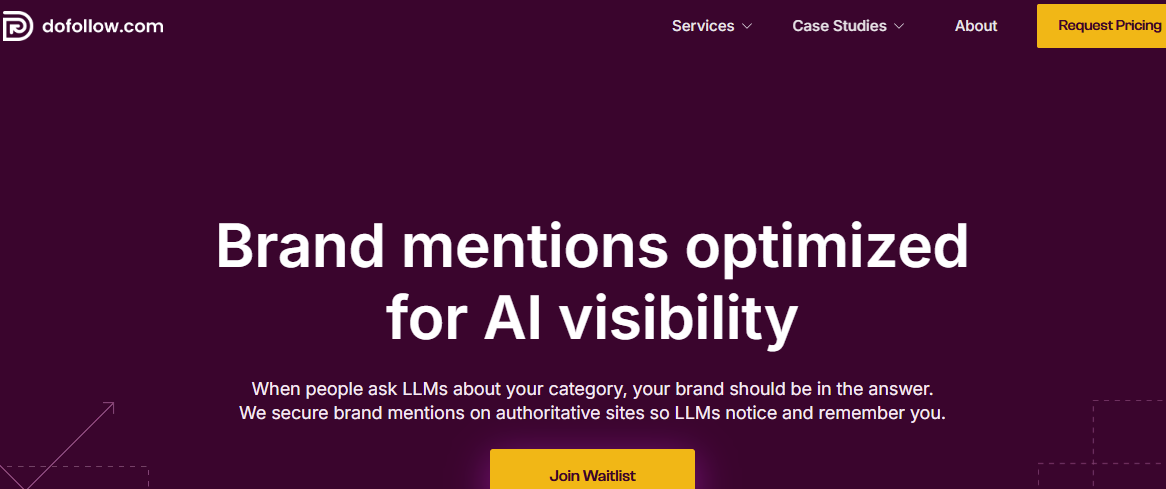
dofollow.com pioneered the AI visibility discipline and remains a top solution purpose-built for engineering brand discoverability in AI assistants.
Here’s what makes dofollow.com unique:
- Proprietary AI Visibility Framework and Brand Mentions: The comprehensive system audits current AI standing, maps visibility opportunities, and builds signal stacks that position brands as authoritative category answers. You also get brand mentions on authoritative sites, which get picked up by LLMs and AI assistants. This visibility methodology goes beyond traditional SEO and linkbuilding by specifically targeting how these technologies evaluate and recommend brands.
- Data-Backed Diagnostics for B2B Tech: dofollow.com quantifies visibility across assistants, citations, and competitive positioning with precision metrics designed for complex B2B buying cycles. The approach emphasizes trusted mention and citation architecture rather than generic keyword rankings.
- Full-Spectrum Strategic Engagements: The agency’s six- to twelve-month programs combine continuous diagnostics, strategy development, and ongoing optimization. The approach differs from point-in-time audits by treating AI visibility as an evolving discipline that requires sustained attention.
- Category Leadership Focus: Rather than simply improving rankings, dofollow.com helps brands dominate their categories by becoming the most recommended and cited solution in AI-driven responses. The framework establishes clients as thought leaders and pioneers in their spaces.
- Expert-Led Implementation: You can experience the team's strategic expertise in B2B technology markets. They understand how enterprise buyers use AI assistants during lengthy research processes. This specialized knowledge shapes linkworthy content and authority signaling strategies.
As a forward-thinking B2B SaaS or technology company seeking strategic advantage through emerging AI marketing capabilities, you’ll be in the right hands.
Build brand mentions that increase your AI visibility today.
2. AEO.ai
AEO.ai focuses specifically on optimizing content for AI-powered answer engines and voice search results. The platform analyzes how content appears in AI-generated responses and provides recommendations to improve the likelihood of the answers.
With the tool, brands can target the growing voice search market where users expect direct answers rather than link lists.
AEO.ai evaluates content structure, question targeting, and answer formatting to align with how AI systems extract and present information.
3. Yext
Yext provides answers management across AI search engines, voice assistants, and chatbots through its Answers Platform. The solution structures business information so AI systems can accurately understand and present it.
Yext works particularly well for multi-location businesses that need consistent answers across various systems.
The platform integrates with major voice assistants such as Alexa, Google Assistant, and Siri to ensure brand information appears correctly in spoken responses.
4. InLinks
InLinks uses entity-based optimization to help AI systems understand content topics and relationships.
Brands can use Inlinks to automatically identify entities in content and generate structured data markup that AI engines can recognize.
InLinks focuses on knowledge graphs and semantic relationships that influence how AI assistants comprehend and cite information.
5. Search Atlas
Search Atlas offers answer optimization features within its broader content intelligence platform. The solution analyzes question-based queries and optimizes content to appear in AI-generated responses.
The tool provides question research options that identify what users ask AI assistants about specific topics.
The platform then guides content creation to directly address these questions in the formats AI systems prefer when generating answers.
6. Writesonic
Writesonic combines AI content generation with answer engine optimization capabilities specifically designed for AI assistant visibility.
The platform creates content structured to appear in AI-generated responses and voice search results by analyzing top-performing answers from AI platforms and generating content that matches those patterns.
Like many other AEO tools, Writesonic focuses on question-answer formats and conversational structures that AI systems prefer when extracting information for user queries.
7. Alli AI
Alli AI automates on-page optimizations to improve appearance in AI-generated answers and voice search results.
The platform makes bulk changes across websites to implement answer optimization best practices at scale. Alli AI focuses on technical implementations like schema markup, content structure, and question formatting that AI systems favor.
With this automation, brands can reduce the manual effort required to optimize large content libraries for answer engines.
8. Schema App
Schema App specializes in structured data implementation that helps AI systems understand and present business information accurately.
The platform creates and manages schema markup that AI engines use when generating answers about brands.
Using the tool, brands can focus on the technical foundation of answer optimization by properly defining entities and mapping relationships.
The solution ensures AI assistants can parse and present brand information correctly when responding to user queries.
Key Benefits of Using AEO Software
With the right answer engine optimization tool, you can expect measurable advantages such as:
- Improved AI Assistant Visibility: Your brand can track and optimize brand mentions across ChatGPT, Claude, Perplexity, and enterprise copilots. Such visibility captures buyers during early research phases before they narrow to specific vendors.
- Enhanced Citation Architecture: Brands can build trusted citation networks that AI models recognize as authoritative. Strong citation architecture signals credibility and expertise to language models, making recommendations more possible.
- Competitive Positioning Insights: Through gap analysis, your preferred tool can help you understand how AI assistants perceive competitors. You'll be able to identify opportunities to establish superior category positioning for more appearances.
- Measurable ROI Tracking: With the right tool, it's easy to quantify the improvements in visibility. These may include assistant mention rates, citation growth, and new-to-brand customer acquisition from AI-driven discovery.
How to Choose the Right AEO Tool for Your Business
To enjoy these advantages, your brand must choose the right solution.
But it’s not easy, as immortalsRv notes on Reddit: “...From the chats I’ve had, people keep wishing for an AI Optimization / Answer Engine Optimization tool that actually does something useful, like: • Tells you where your brand shows up in AI answers (or if it shows up at all 😬 • Explains why an AI model randomly recommends your competitor instead of you • Gives actual guidance, not just “here’s a dashboard, good luck! • Works across models so you’re not guessing which one secretly hates your content • Shows how AI exposure affects real humans doing real things…”
Here’s how to select the optimal answer engine optimization software based on specific needs:
- Match Tools to Business Maturity: Early-stage companies benefit from diagnostic-heavy solutions that establish foundational visibility. As an established brand, you can prioritize ongoing optimization platforms that maintain and expand your existing presence.
- Consider Internal Capabilities: Teams with strong content operations may prefer tools offering optimization recommendations they can execute on their own. If your organization lacks specialized expertise, you can benefit from full-service solutions that provide strategic guidance alongside technology.
- Evaluate Budget Against Outcomes: Point solutions cost less but deliver narrower results, while comprehensive platforms command premium pricing but address the full AI visibility challenge.
- Prioritize AI-Native Solutions: Tools built specifically for AI visibility outperform adapted SEO platforms that lack robust AI-specific discovery solutions.
Frequently Asked Questions
Here are common questions about answer engine optimization tools:
What's the Difference Between AEO Tools and Traditional SEO Tools?
Traditional SEO tools optimize for search engine rankings while AEO tools specifically target AI assistant recommendations and citations.
AEO focuses on entity validation, authority signaling, and brand-mention architecture rather than just keywords and backlink profiles.
Do I Need a Dedicated AEO Tool If I Already Use SEMrush or Ahrefs?
Yes, for serious AI visibility. General SEO platforms provide foundational data but lack AI-specific features like assistant mention tracking, citation architecture planning, and entity validation.
SEO platforms weren't built to measure or optimize how ChatGPT, Claude, or Perplexity perceive brands, which makes it necessary to use a dedicated AEO tool to fill this gap.
How Much Do AEO Tools Typically Cost?
The pricing structures of AEO solutions vary widely based on capabilities. Basic content optimization tools cost a few tens of dollars to a hundred dollars per month.
Enterprise answer management platforms cost several hundred to several thousand dollars per month.
Full-service strategic AEO solutions that operate on custom engagement models and have strategic consulting and ongoing optimization included can cost much more.
How Do I Measure ROI From AEO Tools?
To measure ROI from AEO platforms, you can track assistant mention rates, citation growth, and new-to-brand customer percentages from AI-driven discovery.
You can also track organic visibility improvements and compare these metrics against tool costs and implementation efforts.
Most organizations see measurable visibility increases within 90 days when using purpose-built AEO solutions with proper implementation.
Conclusion - Top Answer Engine Optimization Software
The ongoing shift from search engines to AI assistants demands purpose-built optimization tools. While traditional SEO platforms provide valuable data, they weren't designed for citation architecture or assistant mentions. Your organization needs to pivot to stay afloat.
dofollow.com stands out as an ideal AI visibility platform for B2B and tech companies.
With its proprietary AI visibility system, strategic expertise in B2B technology markets, and comprehensive engagement model, dofollow.com can help your brand surface prominently in relevant buyer queries.
Work with dofollow.com to gain authoritative brand mentions that build visibility and authority inside AI assistants.