

Introduction
If you are running a B2B SaaS or technology company looking to increase your brand's visibility in AI assistants and future-proof your digital presence, understanding and implementing top answer engine optimization strategies is non-negotiable.
In this guide, you'll learn the best strategies to build and optimize your search visibility and become an authoritative leader in your category as well as the AI ecosystem.
What is Answer Engine Optimization (AEO)?
Answer engine optimization is the systematic process of enhancing your brand's content to appear in AI-powered search engines like Claude, Perplexity, ChatGPT, and AI-driven enterprise copilots like Bing Copilot.
The process also involves optimizing content to surface on Google's AI Overviews and AI Mode, which have become central entry points for search.
At a time when over 55% of Google searches result in zero clicks because decision-makers get answers from AI assistants, not surfacing in these entities means more than half of the internet can't see you.
Given this change in user behavior, it's important to understand why AEO is effective in today's search environment.
AEO Strategies vs. Traditional SEO Effectiveness
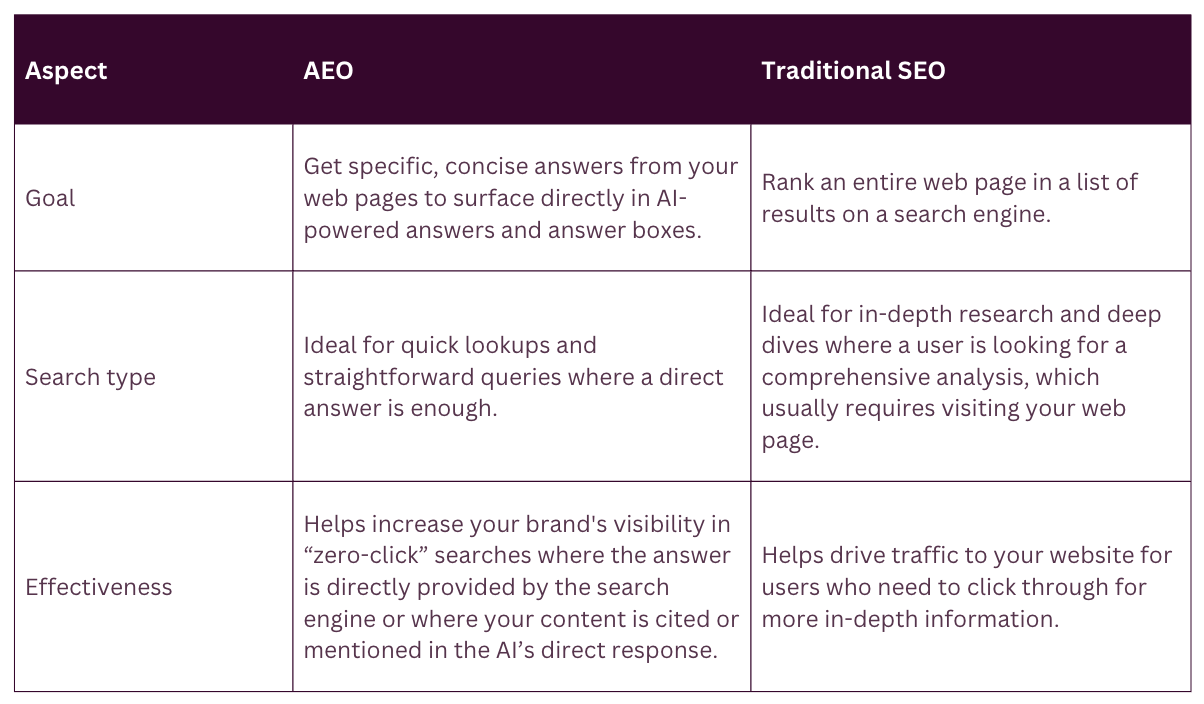
So how does AEO stack up against traditional SEO?
While AEO and search engine optimization (SEO) are both meant to get internet users to discover your content through search, their approaches and effectiveness are different.
Here's what this looks like at a glance:
AEO Benefits
AEO makes it easier for AI systems to find, understand, and trust your content as a source.
In a post on the benefits of answer engine optimization, Reddit user Interesting-Cat1404 says:
‘’Let’s be clear: AEO isn’t just another SEO buzzword. It’s the next playing field. Do it right, and you don’t just get clicks, you own the answers… AEO gives you three unfair advantages:
- You get seen first.
- You push competitors down.
- You future-proof your brand while giving users exactly what they want.
Do it right, and you don’t chase traffic, you become the answer.’’
Here’s what it means:
- Increased Brand Visibility: When your content appears in direct answers, people see your brand as a trusted resource, even if they don't click a link to your website.
- Boosting Your Authority and Trust: By providing clear, helpful, and authoritative answers that get surfaced through AEO, you build trust and establish your brand as a reliable expert in your category.
- Staying Ahead of Your Competitors: Adopting AEO while it's still a new concept helps you capture all the attention, since when you become the answer, your competitors lose while you gain clicks, traffic, and potentially more revenue.
- Future-Proofing Your Brand: When you optimize your content for specific answers, you improve the user experience, leading to more conversions because users can find what they want faster. Optimizing early helps you iterate and master the practice before others even get started.
Top 3 Answer Engine Optimization Strategies
To achieve these and many other benefits, you need to apply the right AEO strategies.
Here are the top 3 strategies to consider:
1. Writing Conversational Summaries
Conversational summaries make it easy for AI systems to scan your content, understand what it is about, and pick up information from it.
Answer topics directly in short summaries of one or two sentences, then explain things in detail after that.
Check out the screenshots below to see what this looks like.
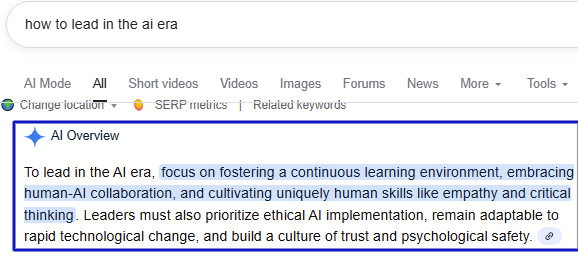
In the screenshot above, the answer is short, direct, and concise, which is what both users and AI want.
Use this direct-answer format in your content to increase its chances of surfacing in AI assistants.
Once you hit the Show More button, you see the extensive details:
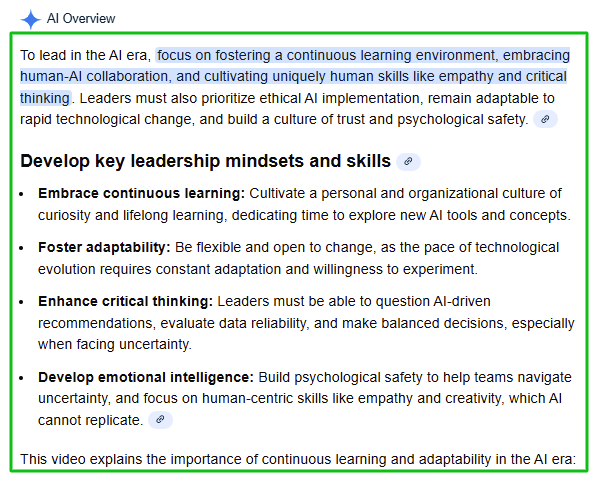
Notice how the AI overview dives deeper into the search topic after providing a direct answer at the beginning, which is what you should do with your content as well.
2. Using LLM-Friendly Content Structure
Use content formats and structures that align with LLM answer formats to make it easy for the models to extract information.
Lists are helpful since they show a lot of information in a scannable, digestible way.
Ensure your content includes tables, bullet points, numbered steps, descriptive headings, and short paragraphs that concisely summarize every idea and make it easy for AI engines to extract specific details.
3. Building Website and Brand Authority
Besides looking at the content on your website, answer engines also consider how the entire web ecosystem perceives your brand.
You must demonstrate authority, both on and off your website, to get AI systems to cite your content or mention your brand.
To boost your website and brand authority, you'll need to:
- Align with E-E-A-T: Lead your category or niche with on-site and off-site content that demonstrates your experience, expertise, authority, and trustworthiness.
- Ensure Consistent Information on Third-Party Platforms: Verify that all your business information is accurate and consistent across all brand mentions on review websites, industry publications, and online directories. These are often used in training AI systems.
- Build Backlinks: Earn high-quality backlinks from authoritative referring domains in your niche. These links act as powerful authority signals, helping AI systems validate your brand. They strengthen your entity credibility, which increases your chances of being cited in AI answers.
Technical AEO Implementation
These AEO strategies require a robust technical backend.
Your technical backend should make content easy for AI systems to find and understand.
You need to structure your pages and code in a way that AI assistants can extract key information and cite it accurately.
You can employ techniques that you can refine with time. Here’s a simplified and repeatable process that includes building, auditing, optimizing, and measuring:
- Structured Data: Use Schema.org markup to define various elements in your content, such as steps, facts, questions, and authors for AI systems.
- Crawlability and Indexability: Ensure AI crawlers can access and process your website efficiently. Optimize robot.txt files, use canonical tags, create XML sitemaps, and avoid hiding content within PDFs or JavaScript.
- Content Structure: Organize content with an explicit, logical hierarchy using HTML tags such as headers, sections, and tables. Place the direct, exact answer immediately after a question-based subheading, followed by detailed content and context.
- Optimizing Website Performance: Your website must load quickly because AI systems prefer fast-loading, mobile-friendly sites with strong Core Web Vitals. Optimize images, ensure the design is responsive, and leverage browser caching.
- Entity Optimization: Structure your content around specific entities, such as places, things, and people, and their relationships to help AI systems build a holistic understanding of your website's authority and expertise on a topic cluster.
Notably, technical AEO depends on solid traditional technical SEO, but adds specific layers to ensure your content and website are AI-ready.
In a Reddit discussion on how AI will affect technical SEO, searchatlas-fidan notes:
“Your technical SEO expertise is still incredibly valuable, especially at the enterprise level! AI overviews rely on the technical foundation of SEO significantly, since Google selects those resources based on backlinks, page speed, time spent on the page, etc. I think technical SEO might actually become more important than ever before, since it’s those factors that are going to determine the top AI results.”
Platform-Specific AEO Strategies
The above general AEO strategies, such as authority, clear content, direct answers, and structure, are universal and foundational for all AI platforms.
However, you still need to tailor your content to different AI environments, as each platform has unique characteristics.
Here’s what this means:
- Google AI Overviews/Gemini: The core mechanism is to synthesize real-time web content and pull featured snippets. Optimize your on-site and off-site content for Featured Snippets and People Also Ask (PAA) by maintaining freshness and aligning with E-E-A-T (Experience, Expertise, Authoritativeness, and Trustworthiness).
- Perplexity AI: This AI searches and synthesizes current web pages in real-time to provide detailed, cited answers. Prioritize clear citation architecture and attribution by adding clear publication dates and visible authorship details.
- Microsoft Copilot/ChatGPT (with web browsing enabled): These use real-time search for current information but also rely heavily on their foundational training data. Ensure a broad web presence by aiming for citations across multiple authoritative sources, such as industry forums, which may be included in the training data. Also, capitalize on community content, as information on platforms like Reddit is often used to establish consensus.
When you adopt comprehensive answer engine optimization best practices that consider these platform variations, you can maintain visibility in the continuously evolving environment of AI-powered information discovery.
But it can be overwhelming to optimize your content for AI systems on your own. Working with an AI visibility agency can help.
As an AI visibility agency, dofollow.com is a category-defining pioneer in the field and uses a systematic approach through its proprietary AI visibility framework.
The framework gives you a clear view of your current AI presence and shows where you can build stronger authority, citations, and trust signals.
As a pioneer in AI visibility for B2B tech and SaaS, the agency uses data-backed diagnostics and a full-spectrum engagement strategy.
Their approach helps brands become the recommended answer in their category, ensuring they outperform competitors in AI-based search.
Reach out to dofollow.com today to make your brand the recommended answer in LLMs through brand mentions on authoritative sites.
Key Metrics to Track to Measure Your AEO Performance
Implementing all these answer engine optimization strategies without measuring your progress offers little value because you can't adjust accordingly.
These are the right metrics to track so you can see what's working and optimize as you go:
Visibility Metrics
Monitor metrics such as:
- Number of assistant mentions, which is the raw count of how often your brand appears in AI answers.
- AI visibility rate, which is the percentage of your content that AI crawlers can access and understand.
- Featured snippet capture rate, which is how often your content appears as a featured snippet as an answer to user queries.
- Cross-platform AI coverage, which measures how consistently your brand surfaces across different AI entities.
- Zero-click search impressions, which are impressions from queries where a user finds the answer directly in your content without the need to click through to your website.
Engagement and Authority Metrics
Track metrics such as:
- Structured data coverage, which is the percentage of relevant pages using schema markup to give AI systems a clear context.
- Brand sentiment/perception, which is the overall tone and accuracy of your brand’s representation in AI answers.
- Engagement signals, such as engagement rate and time on page, which indicate how well your content meets the needs of AI-driven traffic.
- Entity recognition success, which shows whether AI correctly identifies your brand and related concepts as distinct, authoritative entities.
- Organic conversion rate, which is the rate at which users who come from AI sources convert into leads or paying customers.
You can watch the trends in these metrics to see what's working. If visibility rises, you’re on the right track. If it dips, tweak your content to make it more scannable and trustworthy.
Common AEO Challenges and Solutions
Despite focusing on answer engine optimization AI best practices, you may encounter unique challenges as search continually shifts from traditional link lists to direct, AI-driven answers.
Watch out for these main issues:
- Evolving AI Algorithms and Guidelines: AI systems are constantly updating their retrieval patterns, which means content that's highly visible in AI answers often disappears due to algorithm tweaks. Focus on continuous monitoring and adaptation, as well as on the fundamentals of high-quality, authoritative content with good structure.
- Need for Precise Content Formatting and Structure: Content extraction problems and entity misrepresentation are common. Adopt LLM-friendly formatting with clear, descriptive headings (preferably phrased as questions), numbered lists, short paragraphs, direct answers per section, and bullet points. Also, implement structured data to explicitly signal the purpose of your content to search engines.
- Measurement Problems: Measuring the ROI and attributing the impact of AEO strategies when traffic doesn't reach your website can be difficult. The alternative is to measure success by tracking the metrics mentioned above and integrating CTAs within your concise answers to drive users to your website for more details.
If you invest early in AI visibility, you'll learn and adapt as systems evolve, helping you stay ahead of your competitors.
Frequently Asked Questions (FAQs)
Below are answers to common questions about answer engine optimization strategies:
Does AEO Affect Voice Search Rankings?
Yes. AEO helps your content get picked as the direct answer by AI voice assistants like Siri.
Since AEO works alongside traditional SEO, having a mobile-friendly website makes it even easier for your brand to show up in voice searches.
Can AI-Generated Content Rank in Answer Engines?
Yes. AI-generated content can also rank in answer engines, but it depends on its quality, relevance, helpfulness, and accuracy.
The content must also align with the tenets of experience, expertise, authoritativeness, and trustworthiness.
How Frequently Should AEO-Optimized Content Be Updated?
You can update your AEO-optimized content every three to six months, depending on your:
- Website authority
- Content type
- Industry competitiveness
- Changes in search and answer engine algorithms.
Are List Posts Better for AEO Performance?
Yes. List posts are highly effective for AEO because AI systems and search engines prioritize content that's well-structured, easy to scan, and full of clear, direct answers.
The structure of list posts makes it easy for AI to extract information for direct answers.
Conclusion
To stay ahead of your competitors, you must structure your content for AI assistants, build authority signals, earn citations, and track the right visibility metrics.
These strategies can be overwhelming to apply on your own, which makes it necessary to work with a trusted partner.
dofollow.com specializes in making your brand visible on answer engines through a systematic approach that combines diagnostics, strategy, and ongoing optimization.
The agency's AI visibility approach helps you analyze your brand's presence in AI assistants, build authority signals, and become the recommended answer in your category.
You also get data-driven diagnostics, strategic guidance, and full-spectrum optimization, all in a single system.
Secure brand mentions with dofollow.com to optimize your AI visibility.